A good evening starts with a first batch.
Your first dumpling night,
planned for you.
You bring the curiosity. We’ll help with the wrappers, the fold, the pan, and the little things in between.
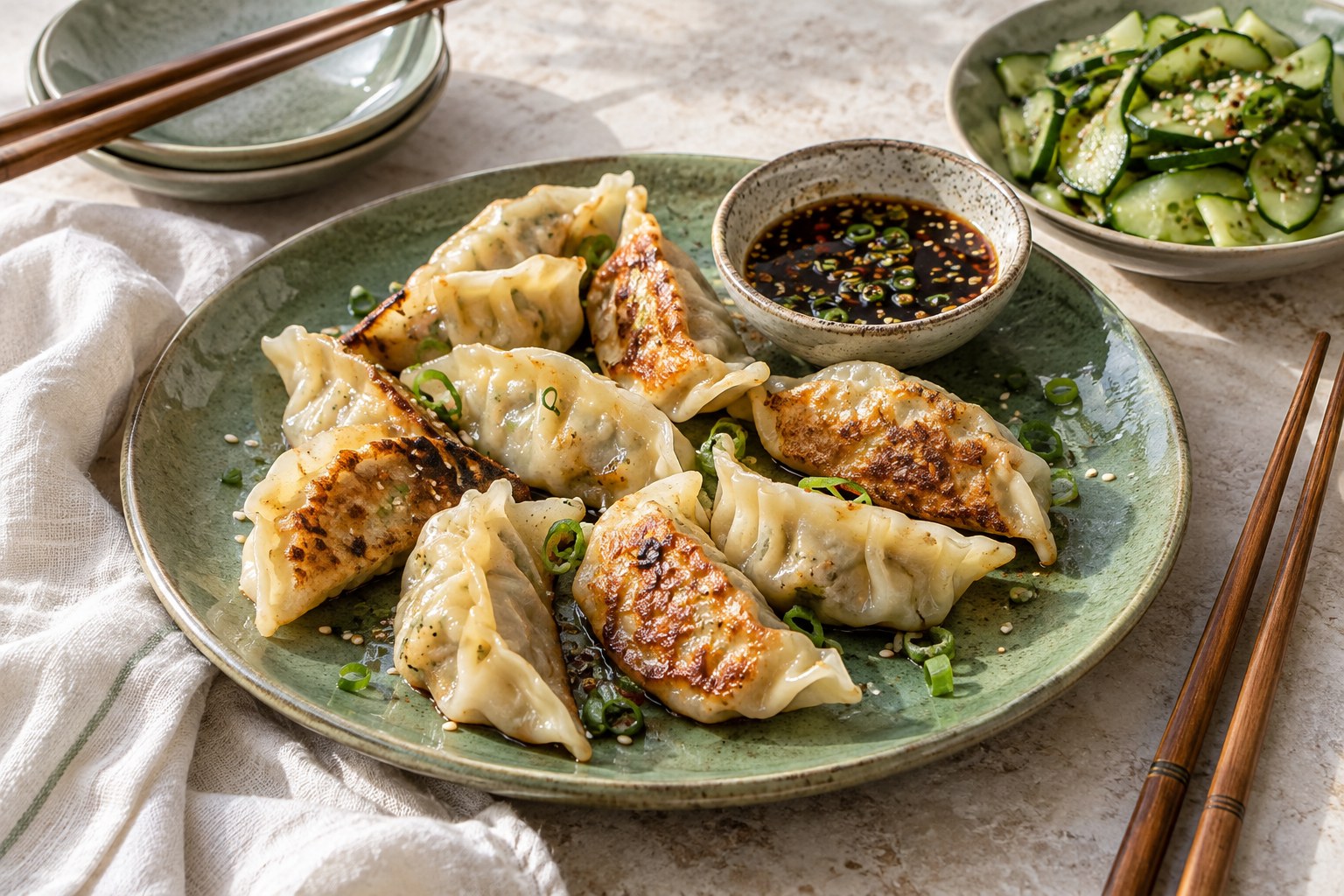
You don’t need perfect pleats.
You need a place to begin.
We’re starting with one approachable path: Chinese-style pan-fried dumplings, made with round wheat wrappers from the store. Choose one filling, take the steps in order, and give yourself room to learn.
Let’s make an evening of it.
First, choose your filling.
Make one filling tonight.
Try the other on your next batch.
Shop once. Set yourself up.
Your selected filling, the right wrappers, and a pan with a lid.
Your shopping list
Wheat, soy and sesame. Wrappers may contain egg; check every package.
Wheat, soy and sesame. Check wrappers for egg and seasonings for animal ingredients before calling the meal vegan.
For either filling
Dip to taste: start with equal spoonfuls of soy sauce and rice vinegar, then dilute with water if you prefer. Wash and slice cucumber for an easy side.
Get ready before you fold.
A little preparation makes the rest feel easier.
Pork & cabbage filling
Soften the cabbage
Warm 1 tsp neutral oil in a skillet over medium heat. Add the finely chopped cabbage and stir until softened and the pan has no pooled liquid.
Cool and combine
Transfer cabbage to a shallow bowl and cool promptly. Mix with the pork, scallions, ginger, soy sauce, sesame oil and salt until cohesive. Never taste raw filling.
Keep it cold
Refrigerate the main bowl. Take out a small working portion for folding; keep raw utensils separate from your sauce and finished food.
Fine cabbage pieces, an evenly mixed filling, and no puddle at the bottom of the bowl.
Mushroom & cabbage filling
Cook the mushrooms
Warm 1 tbsp neutral oil in a skillet over medium heat. Add mushrooms and stir until softened and their released liquid has evaporated.
Add the vegetables
Add cabbage, carrot, scallions and ginger. Cook until softened and there is no pooled liquid. Mix in soy sauce, sesame oil and salt.
Cool before folding
Spread in a shallow container and cool promptly; refrigerate until ready to fold. The filling should hold together on a spoon without dripping. Do not leave it cooling on the counter for hours.
Small, tender pieces with no loose liquid. Cool filling protects the wrapper during folding.
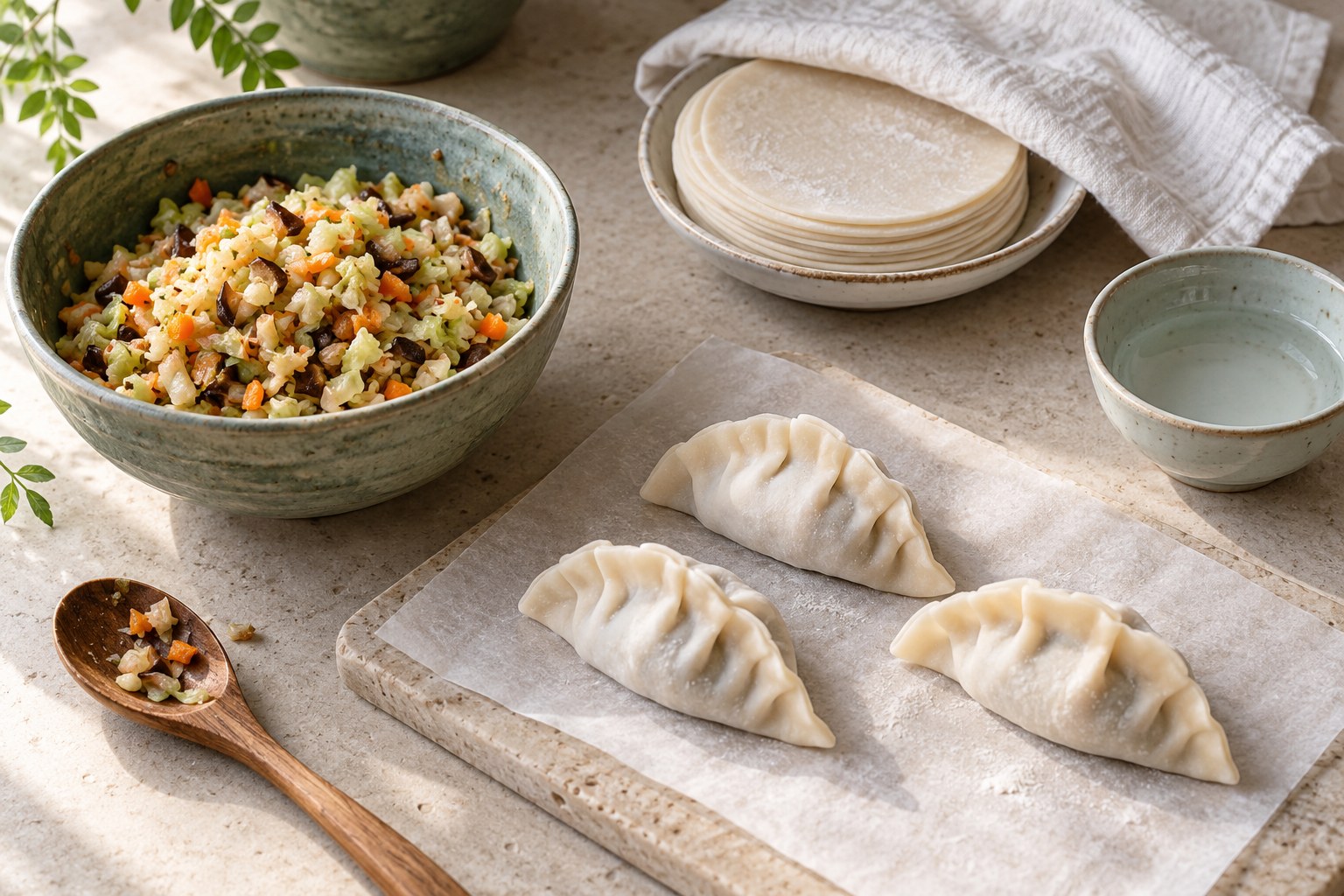
Your folding station
Place a covered wrapper stack, a small portion of filling, a water dish and a lined tray within reach. Make sauce and side first. Use a separate clean plate for cooked food.
Keep perishable filling cold. Total time out of refrigeration should stay below 2 hours, or 1 hour above 90°F / 32°C. Work in small portions; chilling does not undo earlier unsafe exposure.
A simple fold is a good fold.
Make three slowly. Check the seams. Then find your rhythm.
1. Fill the center
Start with a small spoonful, around 2 tsp, in a 3½-inch wrapper. Our portion needs kitchen testing. Reduce it if the edges cannot meet without stretching.
2. Moisten the rim
Lightly wet the edge of a store-bought wrapper with a fingertip. Keep filling off the sealing area. Follow wrapper-specific directions where supplied.
3. Fold and seal
Bring the edges together into a half-moon. Gently release trapped air around the filling and press the entire seam closed. Fancy pleats can wait.
Does the seam stay closed without stretching? Is the filling inside, rather than on the rim? Uneven is fine. A hole or open seam needs another try.
Meet your pan.
Brown, steam, check, then crisp. Stay beside the stove.
Brown
For a pilot batch of 10–12 fresh dumplings in a 10-inch nonstick skillet, start with 1 tbsp neutral oil over medium heat. Leave space between pieces. Inspect the underside; aim for light gold, not a dark crust.
Steam
Have the lid ready. Carefully add ⅓ cup / 80 ml water, using the lid as a splatter shield, and cover. Start checking around 6–8 minutes. Pan, burner and wrapper differences change timing.
Check
For pork, use a suitable fine-tip probe in the filling center of several large pieces from different pan positions, away from the pan. Require 160°F / 71°C. If below this, continue covered steaming with enough water to prevent drying out and recheck.
Crisp
Once the filling is safely cooked and the wrapper is supple, uncover. Let remaining water evaporate and watch the base become golden. Lift gently with a thin spatula; keep watching so it does not burn.
Ground pork: at least 160°F / 71°C, measured in the filling. A golden underside tells you about texture, not meat safety. Vegetable filling is cooked first; the raw wheat wrapper still needs to cook through.
dumpling night.The kitchen companion
Both fillings. One PDF.
A little less scrolling.
A little more cooking.
Your shopping list, two pilot filling formulas, fold diagrams, pan guide, troubleshooting and storage notes. Keep it beside you in the kitchen.
Download the free guideOne free PDF. No account or email needed. Pilot edition.